Top cryptocurrency
The regulatory scene keeps changing with greater emphasis on fraud prevention and consumer protection. Cryptocurrency businesses must keep up with these regulations and build detailed compliance programs https://emergingartistmagazine.com/casino-bingo/. This helps them avoid heavy penalties and stay legitimate.
FL Stat § 896.101 includes virtual currency in its definition of monetary instruments. FL Stat § 560.103 defines a money transmitter as an entity that “receives currency, monetary value, or payment instruments for the purpose of transmitting the same by any means.” FL Stat § 560.125 states that “A person may not engage in the business of a money services business or deferred presentment provider in this state unless the person is licensed.” State v. Espinoza (2019) found that this licensing requirement includes those conducting cryptocurrency transactions, even two-party, individual, ones. The deadline to comply with the Espinoza ruling was the last day of 2021. On May 12, 2022, Governor Ron DeSantis signed HB 273 into law, which revises many of Florida’s existing cryptocurrency statutes. The law defines virtual currency under FL Stat § 560.103 and explicitly includes virtual currency transmitters in the scope of FL Stat § 560. It clarifies FL Stat § 560.125 and partially undoes the Espinoza ruling, stating that money transmitter licenses are only required for “intermediaries” that “transmit…virtual currency from one person to another location or person,” and who have “the ability to unilaterally execute or indefinitely prevent a transaction.” Therefore, two-party, individual transactions will no longer require licensing, but major exchanges still will. HB 273 eases restrictions on these exchanges by excluding virtual currency from the definition of payment instrument and regulating exchanges solely under money service business regulations. It also allows exchanges to only hold virtual currency of the same type and amount owed instead of requiring additional cash reserves. The law takes effect on January 1, 2023, and will solidify Florida as a crypto-friendly state. FL Stat § 559.952 establishes a Financial Technology Sandbox “to allow financial technology innovators to test new products and services in a supervised, flexible regulatory sandbox using exceptions to specified general law and waivers of the corresponding rule requirements under defined conditions.” Under this law, developing blockchain or cryptocurrency businesses with sandbox permission are exempt from needing a money transmitter license during the license period and face less regulatory scrutiny.
GA Code § 7-1-680 defines money transmission as “engaging in the business of receiving money or monetary value for transmission” and virtual currency as “a digital representation of monetary value that does not have legal tender status.” GA Code § 7-1-681 states that “No person…shall engage in…money transmission without having first obtained a license authorizing such activity.” Based on the prior definitions, cryptocurrency transactions fall under this licensing requirement. The Department of Banking and Finance has issued Cease and Desist Orders against unlicensed cryptocurrency platforms, such as with CampBX in 2018. GA Code § 7-1-690 further allows the Department of Banking and Finance “to enact rules and regulations that apply solely to persons engaged in money transmission or the sale of payment instruments involving virtual currency.” GA Code § 53-13-2 defines a digital asset under the Revised Uniform Fiduciary Access to Digital Assets Act as “an electronic record in which an individual has a right or interest. Such term shall not include an underlying asset or liability unless the asset or liability is itself an electronic record.” The Act lays out rules for who can access a person’s digital assets, among other things.
Cryptocurrency market
La primera cadena en lanzar contratos inteligentes fue Ethereum. Un contrato inteligente permite que múltiples scripts interactúen entre sí utilizando reglas claramente definidas, para ejecutar tareas que pueden convertirse en una forma codificada de un contrato. Han revolucionado el espacio de los activos digitales porque han habilitado intercambios descentralizados, finanzas descentralizadas, ICOs, IDOs y mucho más. Una gran proporción del valor creado y almacenado en criptomoneda es posible gracias a los contratos inteligentes.
The total crypto market volume over the last 24 hours is $148.18B, which makes a 22.57% decrease. The total volume in DeFi is currently $8.34B, 5.63% of the total crypto market 24-hour volume. The volume of all stable coins is now $135.8B, which is 91.64% of the total crypto market 24-hour volume.
Bitcoin’s total supply is limited by its software and will never exceed 21,000,000 coins. New coins are created during the process known as “mining”: as transactions are relayed across the network, they get picked up by miners and packaged into blocks, which are in turn protected by complex cryptographic calculations.
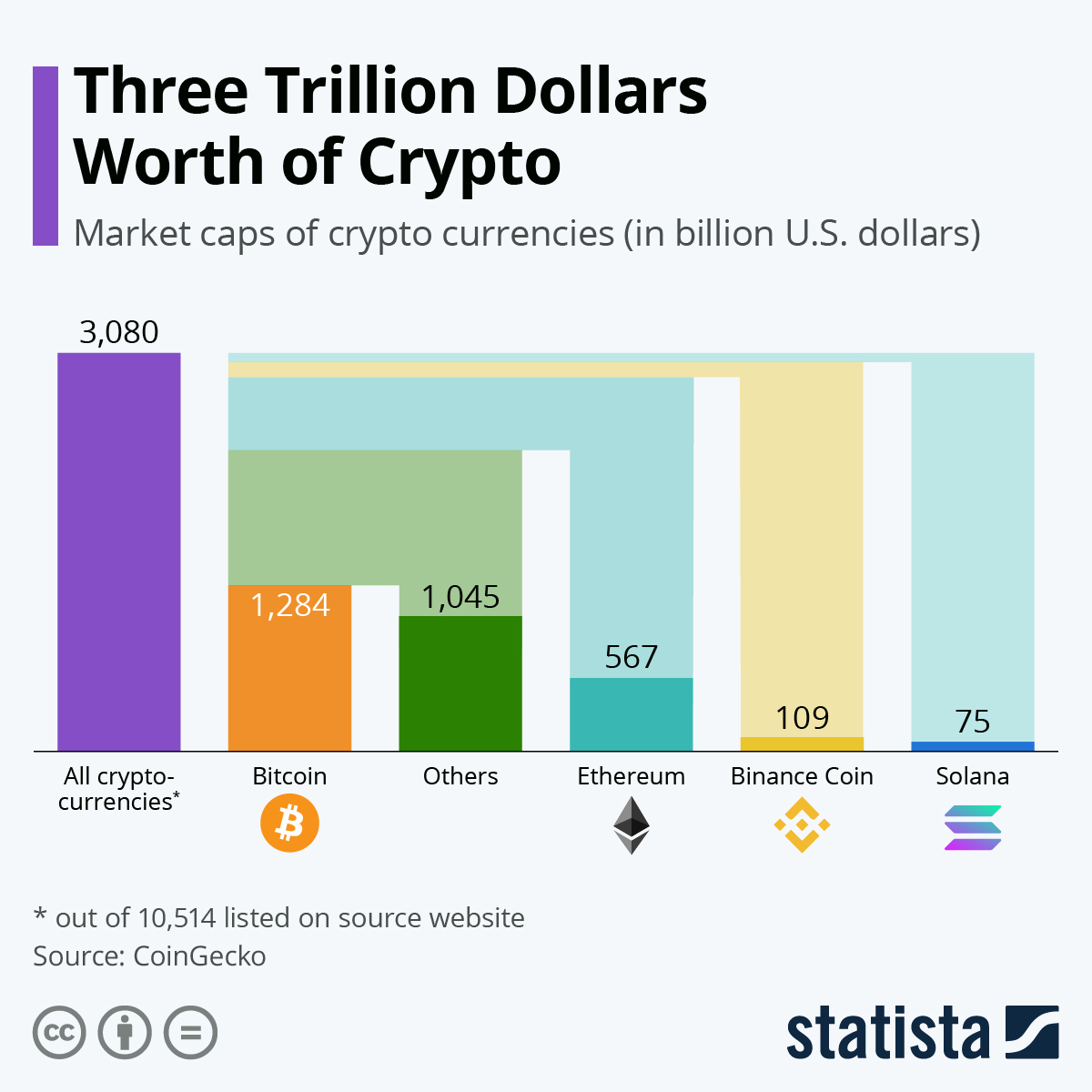
Crypto market capitalization or “crypto market cap” for short is a widely used metric that is commonly used to compare the relative size of different cryptocurrencies. On CoinCodex, market cap is the default metric by which we rank cryptocurrencies on our frontpage. We also track the total cryptocurrency market cap by adding together the market cap of all the cryptocurrencies listed on CoinCodex. The total market cap provides an estimate on whether the cryptocurrency market as a whole is growing or declining.
Let’s quickly calculate the market cap of Bitcoin as an example. The Bitcoin price is currently $ 104,298 and there are 19.81 million BTC coins in circulation. If we use the formula from above, we multiply the two numbers and arrive at a market cap of 2,066.03 billion.
Bitcoin cryptocurrency
Bitcoin’s role in the global economy is evolving as it is adopted by more people every day. As of this writing, it is commonly recognized as a digital currency, a store of value, and a solution for cross-border transactions. Bitcoin’s properties make it uniquely suited for these uses in ways that traditional financial systems cannot match.
Bitcoin’s position as the universally recognized digital money faces occasional challenges from other cryptocurrencies claiming faster transactions, lower costs or enhanced features. Yet, these tradeoffs come at the expense of something fundamental: the ability to serve as money. Across all economies, trading activity consolidates around the “hardest” form of money — the medium best suited to store and transfer value over time.
Bitcoin embodies values of individual liberty, private property and resistance to coercion. It empowers people to save and secure their wealth without dependence on governments or financial institutions, which are often subject to mismanagement and corruption. Bitcoiners view it as a superior form of money designed for saving and spending, not speculating.
One of the biggest winners is Axie Infinity — a Pokémon-inspired game where players collect Axies (NFTs of digital pets), breed and battle them against other players to earn Smooth Love Potion (SLP) — the in-game reward token. This game was extremely popular in developing countries like The Philippines, due to the level of income they could earn. Players in the Philippines can check the price of SLP to PHP today directly on CoinMarketCap.
Bitcoin was launched in 2009 by an anonymous developer or team of developers using the name Satoshi Nakamoto. Unlike traditional currencies, which are controlled and issued by governments, Bitcoin operates on a decentralized network and is not controlled by any central authority.
Bitcoin is the largest and the most popular cryptocurrency, so it’s available to buy and sell on a huge variety of centralized and decentralized crypto exchanges. To buy BTC, you must set up a wallet, then find a platform or exchange to purchase the coins.